
Consistent flour requires uncompromising engineering. At our Wagholi mill, every batch undergoes a 7-stage systematic sequence that removes foreign particles, conditions grain moisture, and preserves natural nutrition.
How our technical setup ensures your private-label brand or wholesale consignment never suffers from gritty texture, uneven moisture, or insect contamination.
Raw wheat arrives at our unloading bay and immediately passes through high-intensity rare-earth magnetic plates to trap ferrous contaminants. It is then fed through high-velocity negative pressure aspirators to lift lightweight dust, chaff, and straw, followed by a vibrating specific-gravity destoner that ejects heavier mud balls, stones, and foreign debris.
Grains pass across multi-deck rotary classifier sieves. Immature grains, broken fragments, and undersized kernels are separated into secondary bypass streams. Only uniform, plump, grade-A whole grains enter the main milling channel.
The wheat undergoes intensive hydro-washing in sanitized potable water to dislodge microscopic dust lodged in the longitudinal crease of the grain. Computerized dampeners then introduce calibrated moisture to toughen the outer bran layer, making it resilient so it peels away cleanly during grinding.
The conditioned grain is transferred to isolated tempering bins where it rests undisturbed for a minimum of 12 hours. This critical rest period ensures moisture migrates evenly throughout the endosperm, making it mellow and responsive to uniform grinding without generating excessive frictional heat.
Tempered grains enter our precision grinding line—comprising both traditional heavy chakki millstones and high-efficiency chilled cast-iron roller mills. Grinding speeds and nip clearances are monitored to keep flour temperatures low, protecting starch damage, aroma, and delicate wheat germ oils.
Ground flour is conveyed pneumatically to multi-sieve plansifters fitted with precision food-grade nylon mesh. The sifting line separates bran flakes and endosperm powder to target micronic granulation. Pneumatic airflow removes any remaining milling heat, bringing the flour to room temperature before packing.
Flour drops into electronic load-cell weighing hoppers. Bags are automatically filled, vibrated for compact settling, and sealed or machine-stitched with heavy nylon twine. Every lot is stamped with batch numbers and tested in our quality lab before dispatch clearance.
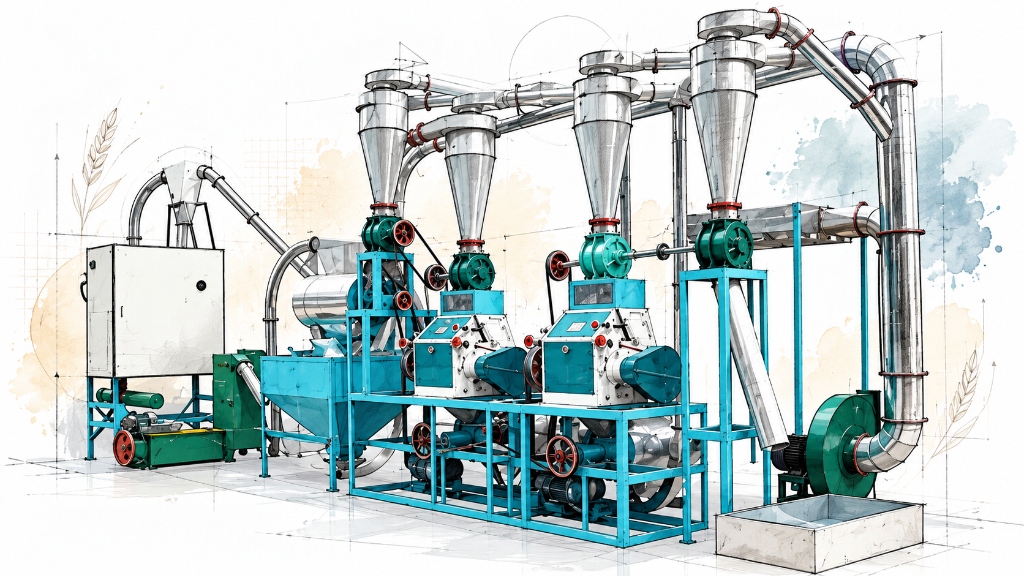
Engineered for continuous, hygienic, and closed-loop pneumatic grain transport from Wagholi, Pune.
We invite private-label brand owners, startups, and wholesalers to request physical product samples to test granulation, water absorption, and chapati texture.